
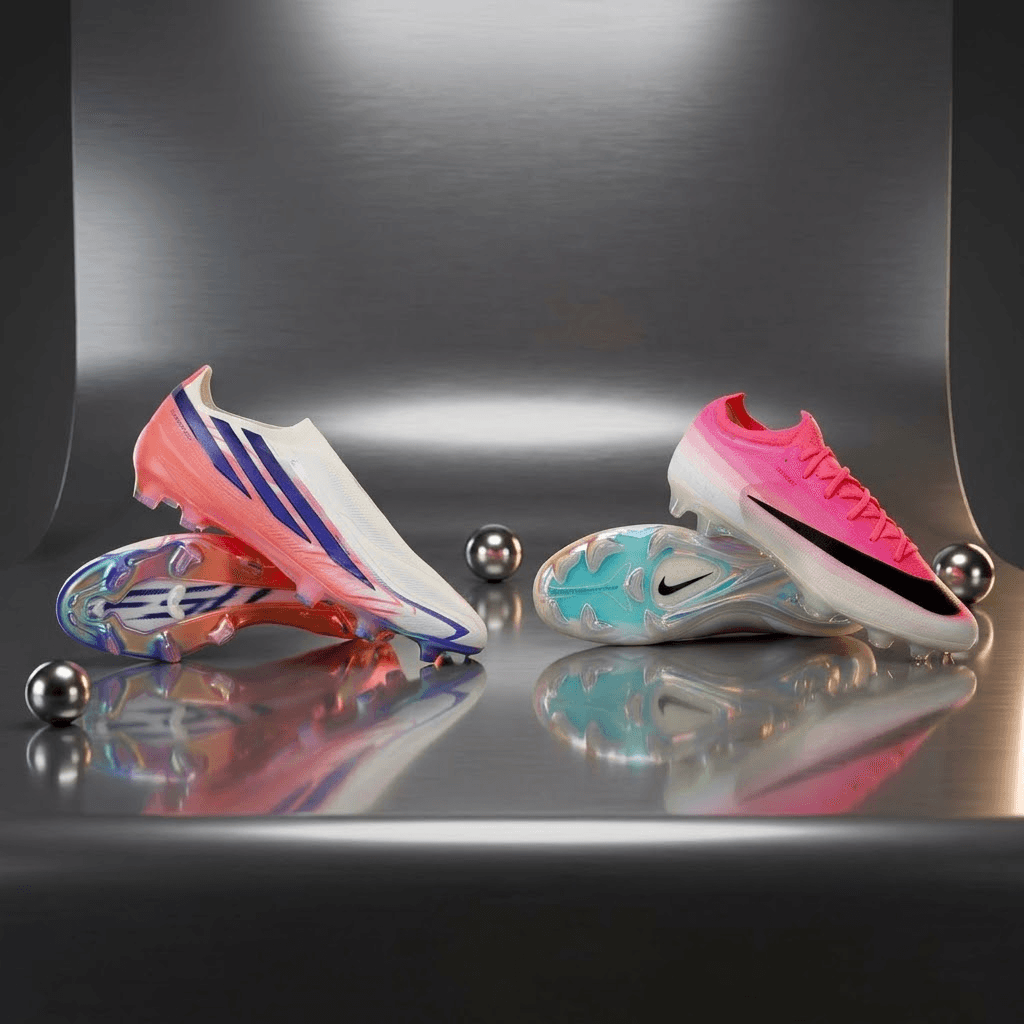
adidas F50 vs Nike Mercurial 2026: Which Speed Boot Wins?
July 28, 2026· By The Boots Tracker Team
Introduction
The 2026 World Cup settled a debate that had only gone one way for years: adidas caught Nike in the speed boot segment. The adidas F50 Elite was the most-worn boot of the tournament at 18.27 %. Right behind it, the Nike Mercurial Vapor 17 Elite at 17.07 %. For the first time in over a decade, Nike's dominance in speed boots is under real threat.
Both boots chase the same goal: maximum speed at minimum weight. The approaches are opposite. The F50 relies on structure and lockdown. The Mercurial relies on a barefoot feel and agility. The differences are subtle, but you notice them on the pitch. Here's how the Elite versions stack up head to head.
adidas F50 Elite: Lockdown and Straight-Line Speed
The F50 is back. After years as a supporting player in the adidas lineup, the 2025/26 reboot catapulted it straight to the top. The philosophy is blunt: anything that doesn't contribute to speed gets cut.
The Technology
The upper is an ultra-thin Engineered Mesh that wraps tightly around the foot. No padding. No extras. The boot aims to feel like a second skin while sitting tighter than Nike's alternative. adidas deliberately chose a more rigid construction. The foot is held in position, not just wrapped.
- Upper: Engineered Mesh, thin and structured
- Soleplate: Carbon-reinforced plate with tuned stud configuration
- Closure: Laceless (Elite) or laced (Elite Laced)
- Weight: 170 g (laceless), 179 g (laced)
- Price: ~€280
The carbon-reinforced soleplate is stiffer than most competitors. That's intentional. A stiff plate transfers energy more directly at toe-off. Less flex means more propulsion per stride. For players who mainly accelerate in a straight line, the advantage is clear.
Then there's the Hyperfast Evo variant. 130 grams. Not a typo. It's the lightest football boot adidas has ever made. The price sits around €350, and the construction is even more uncompromising. Durability under heavy use will be a question. But if you want the lightest tool on the market, this is it.
Who Wears the F50?
Lamine Yamal was the face of the F50 at the 2026 World Cup. His explosive sprints and directional changes on the wing show exactly what this boot is built for. Lionel Messi also wore the F50 at his final major tournament. The player list tells the story: wingers, strikers, pacey full-backs.
Strengths and Weaknesses
The F50 Elite grips the foot like a clamp. That's both its greatest strength and its biggest limitation. Players with wide feet will find the fit too narrow. The laceless version offers almost no room for adjustment. If you need space, try the laced version or go up half a size.
The soleplate is optimised for firm ground (FG). On harder surfaces, cushioning falls short. And the thin upper offers little protection against studs-up challenges.
Nike Mercurial Vapor 17 Elite: Agility and Barefoot Touch
The Mercurial is the most iconic speed boot in football. Since Ronaldo (the Brazilian) wore the R9 in 1998, the Mercurial line has defined what a speed boot should be. The Vapor 17 is the most radical overhaul in years.
The Technology
The headline change is the upper. After twelve years, Nike replaced Flyknit with Atomknit. The result is the thinnest upper Nike has ever put on a football boot. The ball sits practically on your foot. No material in between, just a whisper-thin layer. The sensation when you first put them on is remarkable. It feels like you forgot you're wearing boots.
- Upper: Atomknit (successor to Flyknit)
- Soleplate: FlyLight Plate with Chevron studs
- Closure: Laced, asymmetric placement
- Weight: ~165 g (Elite FG, UK 9)
- Price: ~€275
The FlyLight Plate is more flexible than the F50's soleplate. Nike arranged the studs in a Chevron pattern at angles designed to support rapid direction changes. The philosophy is clear: speed isn't only generated in straight lines. It happens in curves too. Every stud is positioned to grip during push-off in any direction.
Compared to the Vapor 16, Nike claims the Vapor 17 is roughly 20 % lighter. That's a massive leap for a single generation. The difference is noticeable on the pitch.
Who Wears the Mercurial?
Vinicius Jr is the most prominent wearer. His playing style embodies everything the Vapor 17 wants to be: explosive bursts, constant direction changes, close ball control at top speed. Kylian Mbappé also wore the Mercurial line at the 2026 World Cup.
If the Vapor 17 feels too tight or too stripped back, the Superfly 11 is an alternative. Same boot with a high collar, slightly more ankle support, and a different feel on foot.
Strengths and Weaknesses
The Atomknit upper is phenomenally thin. That's its biggest selling point and its biggest risk. Durability over a full season is questionable, especially on artificial grass. Players who regularly get trodden on (wingers, number tens) will feel every contact through the material.
The FlyLight Plate is nimble but less aggressive in straight-line acceleration than adidas's stiffer construction. Nike chose a compromise: good in all directions, dominant in none.
Head to Head: Weight
The Vapor 17 Elite weighs around 165 g. The F50 Elite sits at 170 g (laceless) or 179 g (laced). On paper, Nike wins. In practice, 5 to 14 grams is barely perceptible.
If you want the absolute minimum, the F50 Hyperfast Evo at 130 g is in a category of its own. Though at a significantly higher price and with durability trade-offs.
Verdict: Nike wins narrowly in the standard comparison. adidas takes the extreme category with the Hyperfast Evo.
Head to Head: Upper
This is where the philosophies diverge most clearly. Atomknit (Nike) is thinner and more flexible. Ball feel is more immediate. Engineered Mesh (adidas) is more structured and offers more lockdown. The foot sits more firmly inside the boot.
Players who want maximum ball contact will prefer the Vapor 17. Players who need a locked-in fit will choose the F50. Both priorities are valid.
For short sessions and matchdays, Atomknit is hard to beat. For training and sustained use, the F50's Mesh probably has a longer lifespan.
Head to Head: Soleplate and Traction
The F50's carbon-reinforced plate is stiffer. It stores energy and returns it at toe-off. For straight-line sprints, it's optimal. The downside: on harder surfaces, the lack of flex becomes noticeable. Players who spend a lot of time on artificial pitches should keep that in mind.
The Vapor 17's FlyLight Plate is more reactive. The Chevron studs grip in more directions than the F50's more traditional stud layout. For players who constantly change direction, that's an advantage.
On natural grass: both are excellent. On harder surfaces: Nike has the edge because the more flexible plate adapts better.
Head to Head: Price and Value
| Model | Price |
|---|---|
| adidas F50 Elite | ~€280 |
| adidas F50 Hyperfast Evo | ~€350 |
| Nike Mercurial Vapor 17 Elite | ~€275 |
| Nike Superfly 11 Elite | ~€290 |
The Vapor 17 is marginally cheaper than the F50 Elite. The Hyperfast Evo sits well above both. In terms of value for money, the F50 Elite and Vapor 17 Elite are neck and neck. Both deliver elite-level technology at the expected price point.
If you want to spend less, the Pro tiers of both boots (F50 Pro, Vapor 17 Pro) sit around €170–€190 and offer most of the technology at a reasonable step up from the entry-level models.
Compare on Boots Tracker:
Which Boot Should You Buy?
Both boots are outstanding. The choice comes down to how you play.
Choose the adidas F50 Elite if you:
- Mainly accelerate in straight lines and want raw speed
- Want a firm, uncompromising fit that locks the foot in place
- Prefer stiff soleplates that maximise energy return
- Want the lightest option on the market (Hyperfast Evo)
Choose the Nike Mercurial Vapor 17 Elite if you:
- Constantly change direction and prioritise agility
- Want the thinnest upper and maximum ball feel
- Prefer a more flexible soleplate that adapts to different surfaces
- Value the classic barefoot feel of the Mercurial line
There is no wrong choice. There is only the wrong choice for your playing style. The 2026 World Cup proved both boots perform at the highest level. The F50 overtook the Mercurial as the most-worn boot. That alone says a lot. But statistics don't win matches. The boot that fits your foot and your game is the one that wins.
Related Articles: